
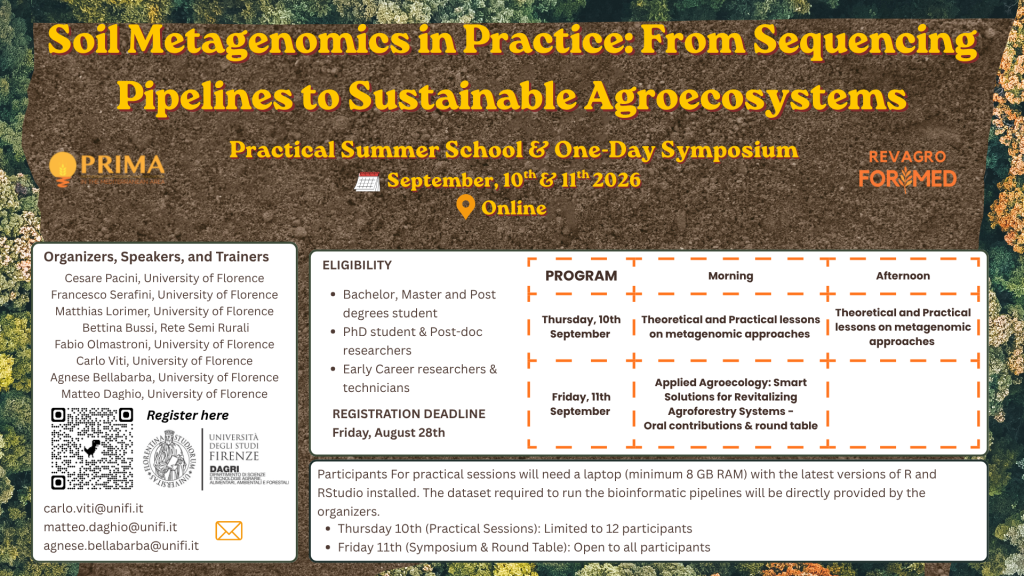
On 10–11 September 2026, RevAgroForMed contributed to the online Practical Summer School and One-Day Symposium “Soil Metagenomics in Practice: From Sequencing Pipelines to Sustainable Agroecosystems.”
The initiative aimed to connect advanced approaches for studying soil microbial communities with their practical application to the development of more sustainable and resilient agricultural systems. A total of 190 people registered for the two-day event, reflecting strong interest in the topics addressed across the Summer School and Symposium.
10 September – Practical Summer School
The first day was devoted to theoretical and hands-on training in soil metagenomics. Participants were introduced to the main approaches used to investigate soil microbial diversity and functions, including:
- 16S rRNA gene amplicon sequencing;
- shotgun metagenomics;
- bioinformatic workflows and data analysis in R.
The practical sessions provided participants with tools for moving from sequencing data to the analysis and interpretation of soil microbial communities. A total of 18 participants took part in the practical session, gaining hands-on experience with the methods and analytical approaches presented during the training.
11 September – Agroecology and RevAgroForMed Symposium
The second day moved from molecular approaches to their application in agroecology and sustainable farming systems. The programme presented some of the innovations and field activities developed within the RevAgroForMed project, including:
- composting techniques and the use of organic amendments to enhance soil fertility and support soil regeneration;
- rhizobial inoculation of alfalfa, linked to the experimental activities carried out at the Poggio ai Legni Lighthouse site;
- evolutionary populations of common wheat in agroforestry systems, exploring crop diversity and adaptation as tools for increasing the resilience of Mediterranean agroecosystems.
The programme concluded with a symposium and round-table discussion, providing an opportunity to bring together different perspectives on soil biodiversity, agroecology and innovative management practices, and to discuss how scientific advances could be translated into practical solutions for farmers and Mediterranean agricultural systems.
The Summer School was open to PhD students, researchers, university students, early-career researchers, technicians and other interested participants, and provided an opportunity for training and exchange across disciplines within and beyond the RevAgroForMed network.
Final Program
Thursday, September 10 th - Theoretical and Practical lessons on metagenomic Approaches
09:00 am - 11:30 am | Microbial diversity profiling by targeted metagenomics and shotgun metagenomics
Matteo Daghio – University of Florence
11:30 am - 13:00 pm | Practical - Analysis of taxonomic marker genes (16S): from raw reads to taxonomic classification with dada2
Agnese Bellabarba – University of Florence
13:00 pm - 14:00 pm | Free time for Lunch
14:00 pm - 18:00 pm | Practical - Analysis of taxonomic marker genes (16S): from raw reads to taxonomic classification with dada2
Agnese Bellabarba – University of Florence
Friday, September 11 th - Applied Agroecology: Smart Solutions for Revitalizing Agroforestry Systems
9:00 am - 9:30 am | Circular Composting Techniques Inspired by Korean Natural Farming for Mediterranean Agroecosystems
Francesco Serafini – University of Florence
9:30 am - 10:00 am | Agroforestry and Cereals: A Study of Common Wheat Evolutionary Populations at the Montepaldi Farm
Matthias Lorimer – University of Florence
10:00 am - 10:30 am | Rhizobial Inoculants: Enhancing Agroecosystem Productivity and Resilience
Carlo Viti – University of Florence
10:30 am – 12:30 pm | Round table
chairs: Cesare Pacini – University of Florence
Bettina Bussi – Rete Semi Rurali
Francesco Pini – University of Bari
Matteo Daghio – University of Florence
Matthias Lorimer – University of Florence & Rete Semi Rurali
Francesco Serafini – University of Florence